
A personal guarantee on a business loan is often the last document in the pack and the one that receives the least attention. By the time it arrives, the terms are agreed, the funds are needed and the guarantee feels like a formality. It is not. It is a personal promise that, if the company cannot pay, you will, and it can stay in force long after the facility that prompted it has been forgotten.
For most established SMEs, guarantees are a normal part of borrowing. Lenders want the people running the business to have a stake in the outcome, and a guarantee gives them that. The question is rarely whether a guarantee will be asked for. It is how much it covers, how long it lasts and whether the wording matches what you think you are agreeing to.
This guide explains how lenders use guarantees, the points worth checking before you sign, and the decisions that protect both your personal position and your future borrowing power.
Why Lenders Ask for a Personal Guarantee
A limited company protects its shareholders from the company's debts. That is the point of incorporation, and it is also why lenders are cautious. If the company fails, the lender's recovery is limited to whatever the company owns. For many SMEs, that is not a great deal once the bank account, debtors and stock are accounted for.
A guarantee closes that gap. It also tells the lender something about commitment. A director who has signed a guarantee has a strong reason to manage the business carefully and to engage early if trading becomes difficult. Underwriters see that as a meaningful part of the credit decision, particularly for younger businesses, those with thin balance sheets, or facilities that are not secured on a specific asset.
It follows that the strength of your application influences the guarantee you are asked for. A business with good management information, a clear repayment source and a well-matched lender is in a better position to discuss the scope of a guarantee than one that has applied in a hurry.
What a Personal Guarantee on a Business Loan Actually Covers
Guarantees vary considerably, and the differences matter. Three points deserve close reading.
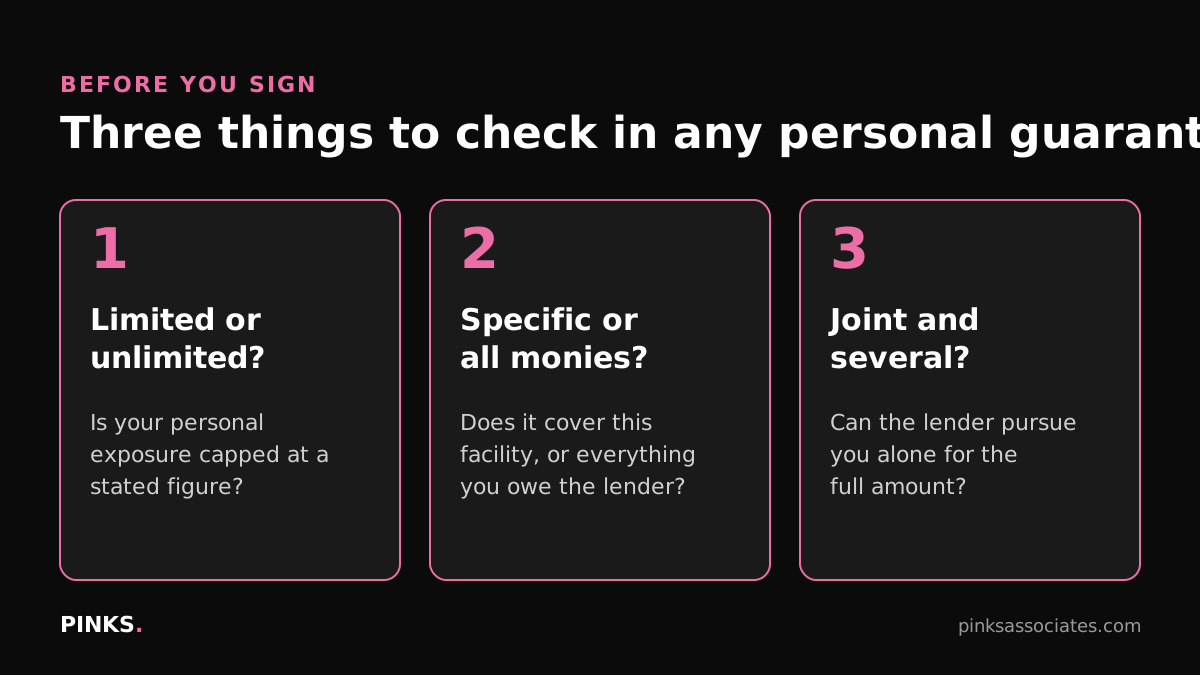
Limited or unlimited
A limited guarantee caps your exposure at a stated figure. An unlimited guarantee does not, and may extend to interest, default charges and the lender's costs of recovery. Where a guarantee is unavoidable, a cap is one of the most valuable things to ask for.
Specific facility or all monies
A specific guarantee relates to a single facility. An all monies guarantee covers everything the company owes that lender, now and in the future. Directors who sign an all monies guarantee for a modest loan can find it later stands behind an overdraft, an asset finance agreement and a larger term loan agreed years afterwards.
Joint and several liability
Where more than one director signs, the guarantee is often joint and several. In plain terms, the lender can pursue any one of you for the full amount, not just your proportionate share. If one co-director has fewer personal assets, the burden can fall disproportionately on the others.
A common misunderstanding. Resigning as a director or selling your shares does not end a personal guarantee. The guarantee usually continues until the lender releases you in writing or the guaranteed debt is cleared. Anyone exiting a business should make a written release part of the exit, not an afterthought.
The Points Worth Negotiating
Lenders do not always move on guarantees, but there is usually more room than directors expect, particularly where the business is strong and the application is well prepared. The points most often worth raising are these:
A cap on the amount guaranteed, ideally below the full facility where other security is available.
A guarantee limited to the specific facility rather than all monies.
A reducing guarantee that falls as the loan is repaid, or a review date after a period of satisfactory trading.
Clarity on whether the lender will look to company assets and other security before calling on the guarantee.
A clear process for release if a director leaves or the business is sold.
None of these are guaranteed outcomes. What changes the conversation is the lender you are talking to and the quality of the case put in front of them. Different lenders take different views on guarantees for the same type of business, which is one of the practical reasons lender selection matters before an application is submitted.
It is also worth knowing that some government-backed lending schemes restrict when lenders can take personal guarantees and exclude a director's main home from security. If you are considering a scheme-backed facility, ask the lender to set out exactly what will and will not be required.
Independent Advice and Personal Guarantee Insurance
Many lenders will ask guarantors to take independent legal advice before signing, and some insist on it. Even where it is optional, it is worth doing. A solicitor will explain what the document means for you personally, which is a different question from whether the facility suits the business.
Spouses and partners deserve particular care. Where a lender asks for a charge over a jointly owned home, or asks a non-director partner to sign, independent advice protects everyone involved and protects the enforceability of the arrangement.

Personal guarantee insurance is a further option. It is designed to cover part of a director's liability if a guarantee is called, and the cost is usually modest relative to the exposure. Policies differ on cover levels, exclusions and the period before full cover applies, so it should sit alongside a well-negotiated guarantee rather than replace one. You can read more about personal guarantee insurance for directors on our site.
Practical step. Keep a simple register of every guarantee you have signed: the lender, the facility, the date, whether it is capped, and whether it is all monies. Most directors cannot answer those questions from memory, and the answers matter when you next borrow, restructure or sell.
How Guarantees Affect Your Future Borrowing Power
Guarantees do not sit in isolation. When you apply for finance in future, a lender will want to understand your existing personal commitments, and outstanding guarantees form part of that picture. A director who has given several unlimited guarantees across different lenders may find that the next lender is less comfortable relying on a further one.
That is why the structure of today's personal guarantee on a business loan has consequences beyond today's facility. A capped, specific guarantee is easier to explain, easier to release and less likely to limit the next conversation. An uncapped all monies guarantee given in haste can follow you through several funding rounds.
The same thinking applies to the order in which you borrow. Securing the most important facility first, on the right terms, often leaves more room to negotiate the scope of guarantees on later borrowing.
Further reading: for more detail on the different types of guarantee, see our guide Personal Guarantees: What You Are Signing and How to Limit the Risk, and our page on business funding for established SMEs.
Speak to Pinks
We are not a volume broker and we do not treat the guarantee as small print. When we structure a facility, we look at the whole position: the lender's appetite, the security available, the guarantee being asked for and what it means for your future borrowing.
If you are about to sign a guarantee, or you have been asked for one and want to understand whether the terms are reasonable for your business, it is worth a conversation before the document is signed rather than after.
No obligation. Tell us what you are borrowing and what guarantee has been requested, and we will give you a plain view of whether it is in line with the market and what might be worth raising with the lender. Talk to us before you sign.
Frequently Asked Questions
Do I have to give a personal guarantee on a business loan?
Not always, but for most limited company borrowing below the mid-market it is common. Lenders use a personal guarantee on a business loan to make sure the directors share the risk, particularly where the company has limited assets or a short trading record. Whether one is required, and how large it needs to be, depends on the lender, the facility and the strength of the business, which is why lender selection matters before you apply.
What is the difference between a limited and an unlimited personal guarantee?
A limited guarantee caps your personal exposure at a stated figure, which may be lower than the facility itself. An unlimited guarantee does not, and can extend to interest, charges and enforcement costs on top of the outstanding balance. Where a guarantee is required, asking for a cap is one of the most useful points to raise before signing.
Does a personal guarantee end when I resign as a director?
No, not automatically. A guarantee is a contract between you and the lender, and it usually continues until the lender formally releases you or the guaranteed debt is repaid. If you leave a business, sell your shares or step back from the board, you should ask the lender for a written release rather than assume one.
What is an all monies guarantee?
An all monies guarantee covers every liability the company owes to that lender, not only the facility you signed it for. That can include later loans, overdrafts or other facilities agreed after the guarantee was given. It is worth checking the wording carefully, because many directors believe they guaranteed one facility when the document covers far more.
Can I insure a personal guarantee?
Yes. Personal guarantee insurance is available in the UK and is designed to cover part of a director's liability if a guarantee is called. Cover levels, exclusions and waiting periods vary, so it should be considered alongside the guarantee terms rather than as a substitute for negotiating them. We can introduce directors to a specialist provider where it is relevant.
Will a broker help me avoid giving a personal guarantee?
A broker cannot remove a lender's requirement, but can often influence it. Some lenders take a lighter approach to guarantees than others for the same type of business, and a well-structured application with strong supporting information can support a request for a capped or reduced guarantee. The point is to understand the options before you commit, not after.
This article is general information and not legal advice. Finance is subject to status and lender criteria. Pinks Associates Limited is a credit broker, not a lender, and an Appointed Representative of Moorgate Finance Ltd T/A MBN, authorised and regulated by the Financial Conduct Authority (FRN 662419). Personal guarantee insurance is arranged by our partner, not by Pinks Associates. Information correct as at November 2026.

