
Most business owners decide they need funding first and ask whether the business is ready for finance second. Lenders work the other way round. Before an underwriter looks at the amount, they are forming a view on whether the business, the people and the numbers support the request. If those answers are not clear when the application lands, the decision is usually slower, the terms are usually weaker, and a decline becomes more likely.
The good news is that lenders are fairly consistent in what they want to understand. The questions are predictable, which means the preparation can be done in advance rather than in a rush once a supplier deadline or growth opportunity has arrived.
Below are the six questions we see lenders ask, in one form or another, on almost every SME application. Answer them well and the case tends to make itself.
1. Where Is the Business Heading?
Lenders are funding the future, not the past. Filed accounts tell them what has happened, but the decision rests on what happens next. An underwriter wants to know what the business does, where it is in its cycle and what the directors expect over the life of the facility.
This does not require a formal business plan for every request. It does require a short, credible explanation: the market you serve, the main customers, what has changed recently and where you expect turnover and margin to go. A business that can explain its direction in a few clear paragraphs is easier to back than one that cannot.
2. What Is the Money For?
A request for “working capital” or “growth” is hard to assess. A request to fund a specific contract, a piece of equipment, a stock position or a defined gap in the cash cycle is much easier. The more precisely the purpose is stated, the easier it is to match the right type of finance to it.
Purpose also drives structure. Equipment usually belongs on asset finance. Cash tied up in invoices often suits invoice discounting. A one-off investment with a clear payback may suit a term loan. Using the wrong product for the purpose is one of the most common reasons a sound business ends up with an awkward facility.
3. Can the Business Afford It?
Affordability is the centre of every credit decision. The lender wants to see that the business generates enough cash, after existing commitments, to meet the new repayments with room to spare. They will look at profit, but they are really looking at cash: when it comes in, when it goes out, and how much headroom is left.
A simple cash flow forecast covering the next twelve months, showing the new repayments, does a great deal of work here. It shows the lender you have thought about affordability rather than leaving them to estimate it.
Where applications fall down. Affordability is often calculated on last year's profit while the business is now running on very different numbers. If trading has changed, for better or worse, lenders expect the application to reflect it. A gap between the story and the current figures undermines confidence quickly.

4. Who Is Behind the Business?
For most SMEs, the directors are the business. Lenders look at experience, track record and personal credit history, and they will usually run searches on the directors as well as the company. Missed personal payments, recent defaults or a pattern of credit searches can affect a business application even where the company itself is performing well.
It is worth knowing what your own file shows before a lender does. Errors can be corrected, and genuine issues can often be explained, but only if you know about them in advance.
5. What Do the Numbers Show Today?
The single most useful document in most applications is a set of up-to-date management accounts. Filed accounts can be well over a year old by the time they reach an underwriter, and a great deal can change in that period. Recent management figures show current trading, current debtor and creditor positions and the direction of travel.
Lenders will also look at bank statements, existing finance and, for many products, the company's business credit score. A clean, well-conducted bank account and a stable credit profile both support the case. Our guide explains how your business credit score is assessed.
6. What Security Is Available?
Security gives the lender a second way out if repayments stop. Depending on the facility, that might be the asset being funded, the debtor book, property, or a personal guarantee from the directors. Understanding what security you have, and what you are prepared to offer, helps determine which lenders and products are realistic.
It is also worth thinking about future borrowing. Security offered today can limit what is available tomorrow, so the aim is to give what the facility genuinely needs rather than everything a lender might accept.
How to Tell If Your Business Is Ready for Finance
Take the first letter of each question and you have a simple checklist: Business direction, Reason for funding, Affordability, Individuals, Numbers and Security. We call it BRAINS, and it is the framework we use with clients before anything goes near a lender.
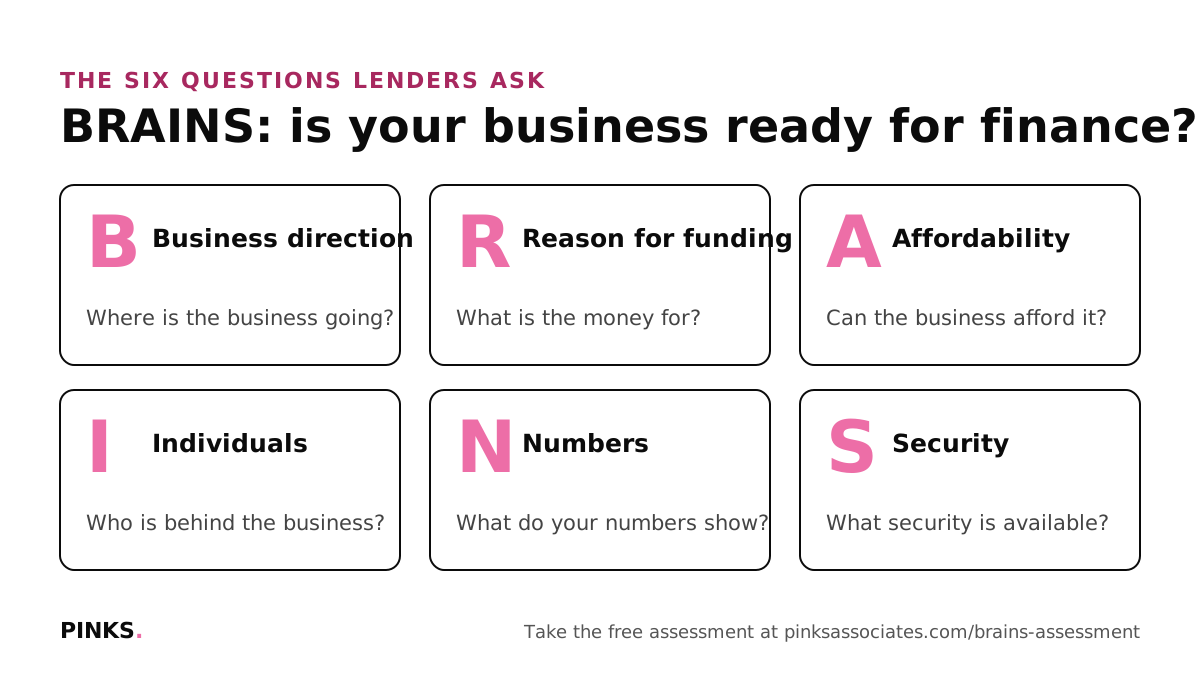
If you can answer all six clearly, with current figures to support you, the business is ready for finance and the application can be positioned with confidence. If one or two answers are uncertain, that is useful information. It tells you what to address first, and it is far better to discover it in a preparation conversation than in a decline letter.
Practical step. Before your next application, write a single paragraph answering each of the six questions. If any paragraph is difficult to write, that is where the lender's questions will focus too. Or take our free BRAINS assessment: fifteen questions, an instant scored report, and no credit search.
Speak to Pinks
Our work starts before the application. We look at your business the way an underwriter will, identify the questions most likely to cause concern, and help you answer them before a lender asks. Only then do we select the lenders whose appetite fits the case.
That approach protects your credit file from unnecessary searches, improves the terms you are likely to be offered, and keeps your future borrowing options open. See our business funding options for established SMEs.
No obligation. Talk us through what you are planning to fund and we will give you a candid view of how ready the business is, what a lender is likely to ask, and what would strengthen the case. Speak to us before you apply.
Frequently Asked Questions
How do I know if my business is ready for finance?
A business is usually ready for finance when it can explain clearly where it is heading, what the money is for, how it will be repaid, who is behind it, what the up-to-date numbers show and what security is available. If any of those answers is vague or relies on old information, it is worth addressing before an application is submitted, because underwriters assess what is in front of them rather than what the business intends to provide later.
What documents do lenders usually ask for?
Most lenders ask for the latest filed accounts, recent management accounts, business bank statements, an aged debtor and creditor report where relevant, and details of existing finance commitments. Larger or more complex requests may also need a cash flow forecast and a short explanation of the purpose and repayment plan. Having these ready before you apply shortens the process and reduces the number of follow-up questions.
Does a loss in my last accounts mean I cannot borrow?
Not necessarily. Lenders look at the reason for the loss and what has happened since. A one-off cost, an investment year or a disrupted period can be explained, particularly if current management accounts show a recovery. What concerns lenders is an unexplained loss with no evidence of a change in direction, so the explanation and supporting figures matter as much as the headline result.
How far ahead should I prepare before applying for finance?
Ideally a few months, and longer for larger facilities. That gives time to bring management accounts up to date, review the business and director credit files, correct any errors, and decide which lender is most likely to suit the request. Preparing early also avoids the pressure that leads businesses to apply widely and accumulate unnecessary credit searches.
Will checking whether I am ready for finance affect my credit score?
Reviewing your own position does not involve a lender credit search and should not affect your credit file. A readiness conversation with a broker is also typically carried out before any application is made. The searches that matter are those carried out when a full application is submitted, which is why it makes sense to be confident about fit before that point.
Can a broker help if my business is not ready yet?
Yes, and that is often where the most useful work happens. A broker can identify which parts of the case are likely to concern a lender and what would strengthen them, whether that is better management information, a clearer explanation of purpose or a different facility structure. Waiting a few months and applying once, well prepared, usually produces a better result than applying now and being declined.
This article is general information. Finance is subject to status and lender criteria. Pinks Associates Limited is a credit broker, not a lender, and an Appointed Representative of Moorgate Finance Ltd T/A MBN, authorised and regulated by the Financial Conduct Authority (FRN 662419). Information correct as at November 2026.

